The BASICS of recording a real drum kit??

Mitglied
Posts: 50
Joined: 09.04.2016
Greets,
The title is posed as a question to drummers here that actually record REAL drum kits. Not everyone out there is familiar with the how's of recording drums for use here on wikiloops. I have a few drummer friends who are very good but are a bit in the dark as to what they will need and then how to go about it.
If some drummers here could post a basic run down - description and list recommendations on the tools needed ( kinds of interfaces, microphones etc) and suggestions on how to go about it (mic placements, mic cords, best mics to use, panning, and whatever else you have learned)...Imagine a complete newbie who wants to record their drum kits and upload here to wikiloops. Some beginners may want to use laptops and others Iphones etc...
I believe it would be very helpful...
I briefly searched the forum and was unable to find anything as i have described above.
The title is posed as a question to drummers here that actually record REAL drum kits. Not everyone out there is familiar with the how's of recording drums for use here on wikiloops. I have a few drummer friends who are very good but are a bit in the dark as to what they will need and then how to go about it.
If some drummers here could post a basic run down - description and list recommendations on the tools needed ( kinds of interfaces, microphones etc) and suggestions on how to go about it (mic placements, mic cords, best mics to use, panning, and whatever else you have learned)...Imagine a complete newbie who wants to record their drum kits and upload here to wikiloops. Some beginners may want to use laptops and others Iphones etc...
I believe it would be very helpful...
I briefly searched the forum and was unable to find anything as i have described above.
+2

SUPPORTER
Posts: 2976
Joined: 30.12.2010
So, I have at times tried to record my kit (the Baer tracks on wikiloops), so, I might be eligible to answer this :)
Recording drums the professional high end way is ... hard and expensive, and the amount of time and knowledge that goes into tuning, placement, mic choice and so on is endless,
just as a warning, this is not a simple matter, and if you want your recordings to match today's average edrum kits sounds, this is a long way off any amateur setup.
So, that being said, here's how you could start with a rough & cheap setup that will get you going, and that will give you lots of testing and editing options if you want to dig into that alley.
What you'll need is some sort of input device that can accept at least four XLR mic inputs, and can serve phantom power to at least two mics. You dont need to understand what that is, just make sure it's onboard, it basically serves a little electricity to condenser mics, they dont work without it.
So, 1. usb interface with 4x XLR, phantom power, adjustable preamps (one knob per input for pre-leveling),
then:
1x pair of condenser overhead mics on a stand with a large extension + a double holder bar so you can mount them in the classical V stereo positioning, with the mics forming the letter V and their membranes being on the end where the lines touch.
You'll place that V so it hovers one yard above your center toms, with the mics pointing towards HiHat and Ride cymbals.
1x big membrane dynamic kick drum mic, place that outside the bassdrum facing the resonator head - or slightly inside if you have an opening in the resonator head.
Since you have four channels and want some extra smack on the snare, add
1x SM58 mic on a small stand and close mic your snare head
4x xlr cables to connect mics to converter box ...
and some software that can record the four incoming signals - you have a good chance of getting that for free when buying a usb converter.
First recording will sound pretty low-fi, and you might wonder why you need an extra snare mic, as the snare blurts out thru the overhead mics pretty evil as well...
So, a quick rundown of how to improve the first result:
1st: check that no track ever clips / exceeds highest peak level. Meters are sometimes slow, the highest peak you should see should touch -3db, keep a safe distance to 0 db levels.
2nd: EQ out some lower frequencies on the overheads, and some high frequency from the bassdrum mic
3rd: don't hesitate to have the kick at a very high level in the mix and the overheads comparably low, that is not unusual, go by ear, kicks gotta be strong (mp3 conversion will eat some of that later on, too)
4th since we reduced bass freqs on the overheads, the snare will now sound a bit tinny on them, that is where the 4th mic comes in to re-enforce the lower freqs of the snare, so it cuts thru with a bit more punch.
5th: If you are catching too much "roomy" natural reverb, your overheads are placed too far away, or your room needs some more carpets - find a good balance, try different positions.
6th: try to mix as if you were hearing someone play drums in front of you. It is confusing, because the mixed drumset usually stands facing the listener (as it would on a stage), whilst you are used to hearing it from behind. So yes, hihats are expected to be panned to the right and rides to the left, you get what I mean.
7th: true stereo is super hard to achieve, if your tom-tom roll down the set does sound a little like the drums form a line, then that is a great result - dont overdo it and end up with hihats only on the right speaker, that sort of extreme panning is... not helpfull.
The overheads will be panned all left and right in the mixing software, but the V-Positioning angle of the mics is not extreme 180° opposition. It should record a shared field with a common center and some left and right orientation. Just imagine these overheads were flashlights pointing at your set - get to know which areas they are "lighting up", make sure you have no darkness in the middle of the set and don't leave the outer cymbals in the dark either...
Hope this helps someone a little, recording drums is a lifelong journey I'm afraid:)
p.s.
You might want to check out some of Baers tracks, i added some tom mics to the setup a few years ago, but the basic four channel thing is what delivers the non-tom sound... I make up for the setup by mixing tricks, that's another book then.
One should also re-visit MrAdamOnDrums tracks on wikiloops, he had the habit of recording the entire set with ONE microphone. The result is special, but not bad either.
Recording drums the professional high end way is ... hard and expensive, and the amount of time and knowledge that goes into tuning, placement, mic choice and so on is endless,
just as a warning, this is not a simple matter, and if you want your recordings to match today's average edrum kits sounds, this is a long way off any amateur setup.
So, that being said, here's how you could start with a rough & cheap setup that will get you going, and that will give you lots of testing and editing options if you want to dig into that alley.
What you'll need is some sort of input device that can accept at least four XLR mic inputs, and can serve phantom power to at least two mics. You dont need to understand what that is, just make sure it's onboard, it basically serves a little electricity to condenser mics, they dont work without it.
So, 1. usb interface with 4x XLR, phantom power, adjustable preamps (one knob per input for pre-leveling),
then:
1x pair of condenser overhead mics on a stand with a large extension + a double holder bar so you can mount them in the classical V stereo positioning, with the mics forming the letter V and their membranes being on the end where the lines touch.
You'll place that V so it hovers one yard above your center toms, with the mics pointing towards HiHat and Ride cymbals.
1x big membrane dynamic kick drum mic, place that outside the bassdrum facing the resonator head - or slightly inside if you have an opening in the resonator head.
Since you have four channels and want some extra smack on the snare, add
1x SM58 mic on a small stand and close mic your snare head
4x xlr cables to connect mics to converter box ...
and some software that can record the four incoming signals - you have a good chance of getting that for free when buying a usb converter.
First recording will sound pretty low-fi, and you might wonder why you need an extra snare mic, as the snare blurts out thru the overhead mics pretty evil as well...
So, a quick rundown of how to improve the first result:
1st: check that no track ever clips / exceeds highest peak level. Meters are sometimes slow, the highest peak you should see should touch -3db, keep a safe distance to 0 db levels.
2nd: EQ out some lower frequencies on the overheads, and some high frequency from the bassdrum mic
3rd: don't hesitate to have the kick at a very high level in the mix and the overheads comparably low, that is not unusual, go by ear, kicks gotta be strong (mp3 conversion will eat some of that later on, too)
4th since we reduced bass freqs on the overheads, the snare will now sound a bit tinny on them, that is where the 4th mic comes in to re-enforce the lower freqs of the snare, so it cuts thru with a bit more punch.
5th: If you are catching too much "roomy" natural reverb, your overheads are placed too far away, or your room needs some more carpets - find a good balance, try different positions.
6th: try to mix as if you were hearing someone play drums in front of you. It is confusing, because the mixed drumset usually stands facing the listener (as it would on a stage), whilst you are used to hearing it from behind. So yes, hihats are expected to be panned to the right and rides to the left, you get what I mean.
7th: true stereo is super hard to achieve, if your tom-tom roll down the set does sound a little like the drums form a line, then that is a great result - dont overdo it and end up with hihats only on the right speaker, that sort of extreme panning is... not helpfull.
The overheads will be panned all left and right in the mixing software, but the V-Positioning angle of the mics is not extreme 180° opposition. It should record a shared field with a common center and some left and right orientation. Just imagine these overheads were flashlights pointing at your set - get to know which areas they are "lighting up", make sure you have no darkness in the middle of the set and don't leave the outer cymbals in the dark either...
Hope this helps someone a little, recording drums is a lifelong journey I'm afraid:)
p.s.
You might want to check out some of Baers tracks, i added some tom mics to the setup a few years ago, but the basic four channel thing is what delivers the non-tom sound... I make up for the setup by mixing tricks, that's another book then.
One should also re-visit MrAdamOnDrums tracks on wikiloops, he had the habit of recording the entire set with ONE microphone. The result is special, but not bad either.
+4
Harley Benton TE-52 NA Vintage Series
Electric Guitar

159 €
iThis widget links to Thomann, our affiliate partner. We may receive a commission when you purchase a product there.
Shop besuchen

Mitglied
Posts: 541
Joined: 04.07.2020
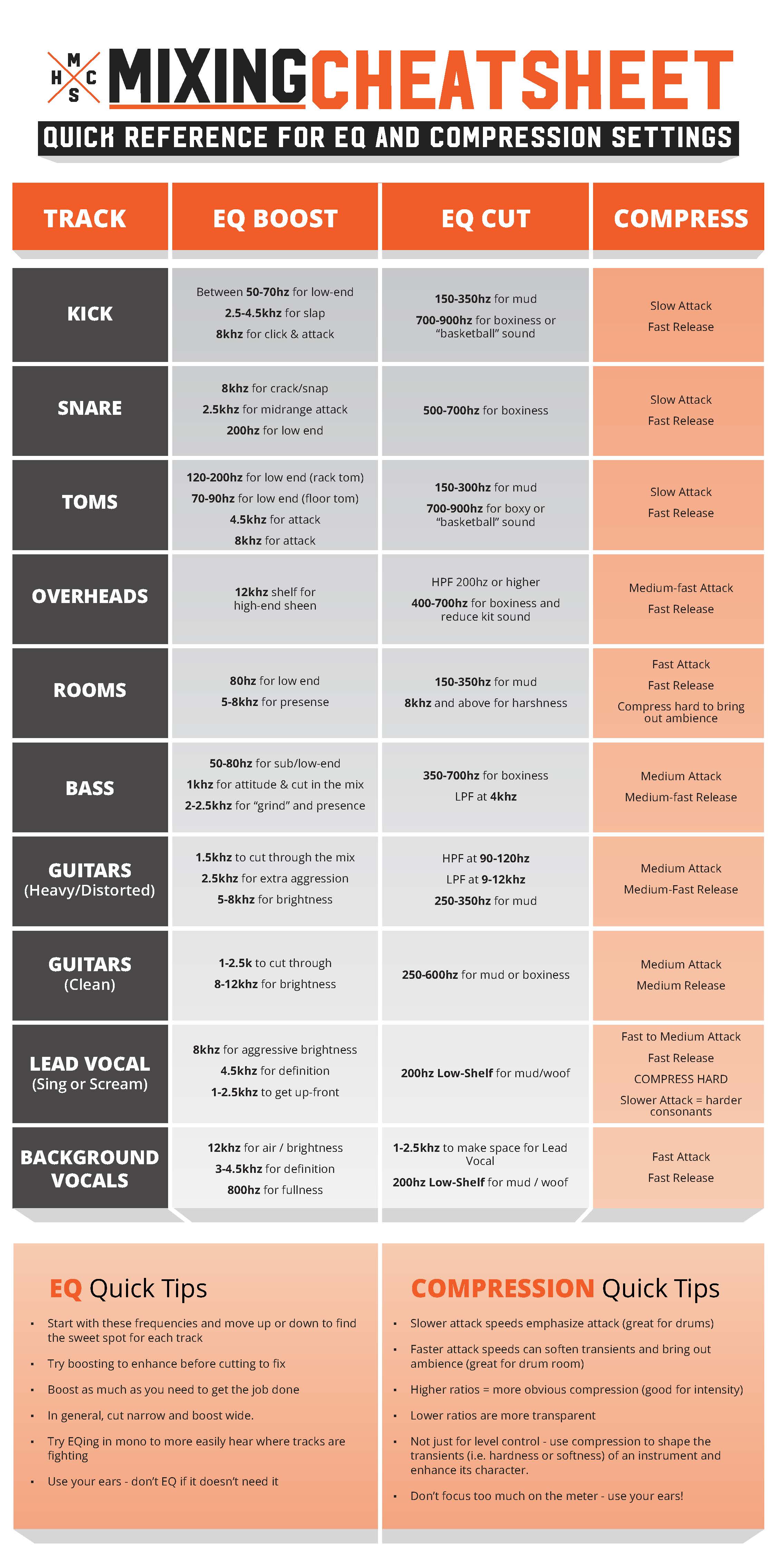
don't know if this helps, it couldn't hurt at least :) i'll use this cheat sheet from time to time as a reminder. there's some drum EQ stuff in there that is probably some baseline info.
cheers! :W
(editing, attaching a JPG, apparently PDFs don't work within WL)
rootshell attached the following image:
Edited by rootshell on 13. Januar 2026 um 22:21
cheers! :W
(editing, attaching a JPG, apparently PDFs don't work within WL)
rootshell attached the following image:
Edited by rootshell on 13. Januar 2026 um 22:21
+2
Mitglied
Posts: 50
Joined: 09.04.2016
Thanks Dick and Nick! I will share the info link with the person that was asking about the how to's....Dick just a quick question. Could one use a small powered mixer that had four XLR inputs and just run that into an interface or not a good idea? Better to have a 4 XLR input interface? Nick the JPG was helpful...
Thanks again and hopefully this thread might help some drummers who want to start recording...:)
Thanks again and hopefully this thread might help some drummers who want to start recording...:)
+1
SUPPORTER
Posts: 2976
Joined: 30.12.2010
Hey,
sure, a mixer would work as well, but it has the downside that you have to set the mixing levels between the mics on the mixer, which then gives you a stereo mix to record.
You simply cannot EQ the bassdrum or alter its volume once you have mixed that together, so, it's a one-shot situation where either your mixer is configured absolutely great, or the recording is shitty. That can be totally frustrating, especially if you do it by yourself and go over setting the mics, setting the mixer (while nobody is playing!), doing a recording, listening to that, adjusting the mixer hoping that will help, repeat procedure... you can go nuts doing that, hence the recommendation to simply capture your signals and do the mixing/editing afterwards.
I have not once been able to establish a fixed setup that actually sounded the very same for three months straight, drums go out of tune, humidity changes the acoustics... so, one better gives up on the thought of "getting that superbe setup right once and then keeping that", it does not work that way with real drums.
sure, a mixer would work as well, but it has the downside that you have to set the mixing levels between the mics on the mixer, which then gives you a stereo mix to record.
You simply cannot EQ the bassdrum or alter its volume once you have mixed that together, so, it's a one-shot situation where either your mixer is configured absolutely great, or the recording is shitty. That can be totally frustrating, especially if you do it by yourself and go over setting the mics, setting the mixer (while nobody is playing!), doing a recording, listening to that, adjusting the mixer hoping that will help, repeat procedure... you can go nuts doing that, hence the recommendation to simply capture your signals and do the mixing/editing afterwards.
I have not once been able to establish a fixed setup that actually sounded the very same for three months straight, drums go out of tune, humidity changes the acoustics... so, one better gives up on the thought of "getting that superbe setup right once and then keeping that", it does not work that way with real drums.
+8
Mitglied
Posts: 50
Joined: 09.04.2016
I appreciate the time taken to respond so thoroughly! Thank you Dick! Some real good tips....
+2

SUPPORTER
Posts: 5
Joined: 03.01.2018
[quote]rootshell wrote:
don't know if this helps, it couldn't hurt at least :) i'll use this cheat sheet from time to time as a reminder. there's some drum EQ stuff in there that is probably some baseline info.
cheers! :W
So...
Where's the horn section???:D
don't know if this helps, it couldn't hurt at least :) i'll use this cheat sheet from time to time as a reminder. there's some drum EQ stuff in there that is probably some baseline info.
cheers! :W
So...
Where's the horn section???:D
+2

SUPPORTER
Posts: 246
Joined: 01.01.2017
Ivanovitch wrote:
Where's the horn section???:D
Where's the horn section???:D
I guess it is covered by the second-to-last line: "Lead Vocal / Sing or Scream" :D
+2
Fender AV II 63 TELE RW RED TRANS
Electric Guitar

2.249 €
iThis widget links to Thomann, our affiliate partner. We may receive a commission when you purchase a product there.
Shop besuchen
Mitglied
Posts: 541
Joined: 04.07.2020
Ivanovitch wrote:
[quote]rootshell wrote:
don't know if this helps, it couldn't hurt at least :) i'll use this cheat sheet from time to time as a reminder. there's some drum EQ stuff in there that is probably some baseline info.
cheers! :W
So...
Where's the horn section???:D
[quote]rootshell wrote:
don't know if this helps, it couldn't hurt at least :) i'll use this cheat sheet from time to time as a reminder. there's some drum EQ stuff in there that is probably some baseline info.
cheers! :W
So...
Where's the horn section???:D
definitely missing that horn section for sure :W
+2

SUPPORTER
Posts: 2145
Joined: 27.09.2014
Asking for a friend: With a cowbell installed on the kit, does this get it's own microphone, considering it is probably the most crucial instrument in a band? B)
+3

SUPPORTER
Posts: 100
Joined: 04.07.2014
Major 3rd wrote:
...I have a few drummer friends who are very good but are a bit in the dark as to what they will need and then how to go about it.
If some drummers here could post a basic run down - description and list recommendations on the tools needed ...
...I have a few drummer friends who are very good but are a bit in the dark as to what they will need and then how to go about it.
If some drummers here could post a basic run down - description and list recommendations on the tools needed ...
Although not a drummer but a bassplayer I think I can give some advice based on my experience.
A technique that according to articles and new microphones on the internet is gaining popularity is a pair of figure 8 microphones in a so called Blumlein setup. In one of my last bands the drummer had his kit in the rehearsal room. Occasionally it was miked up and there was an interface to record it on the laptop he brought along. Although he didn't have much knowledge on how to deal with the occuring phase-shifting between the microphones he had enough microphones. Amongst them a nice set of paired condensers he used as overheads. I managed to get him to test this pair in a Blumlein position that we initially placed about 1m above ground and 1m in front of his kit.
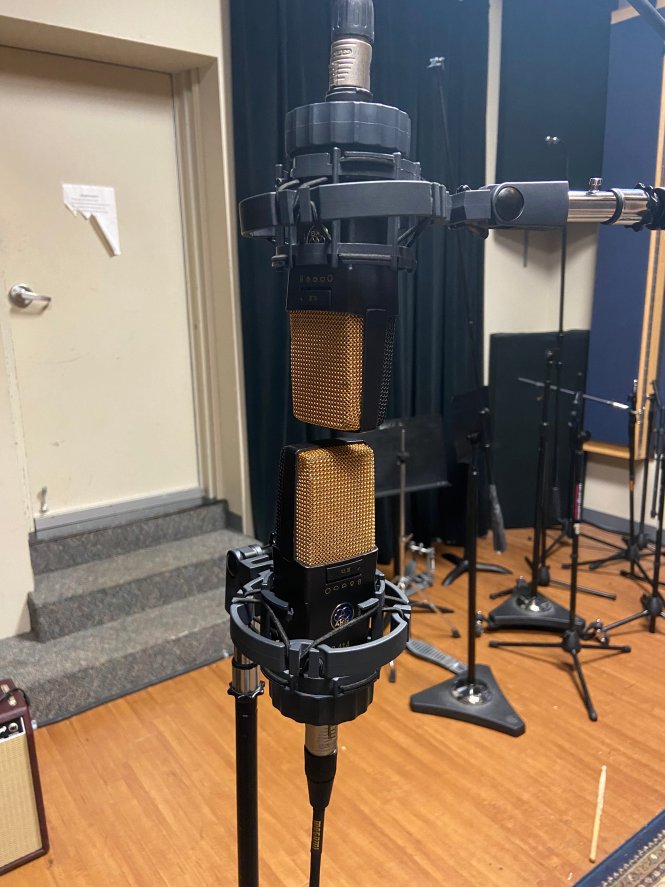
The Blumlein setup is two figure 8, aka bi-directional, pattern microphones placed above each other in a 90 degrees angle. so basically in a birds-eye view both 8's would be basically listening in 4 directions where one is 'facing' to the left side and one to the right side of the kit. so from the view of the drummer like an x and not like a + ;) - See image below -
To influence the balance between kick, toms and cymbals we found out that you can finetune with a relative small up or down movement of the microphones. And after some more experimenting we found out you can get a more 'modern and roomy sound' by simply moving the microphones a bit further from the kit. Of course the room itself is the bringer of the 'color' there but a 'lesser' sounding drum-room will probably already be dampened more. ;)
As both membranes are almost touching phase shifting isn't an issue. And it was amazing how much detail and how balanced the sound and stereo-mix already was before any processing was done.
A sound example: At the beginning of this video you can hear the Blumlein setup, expanding into the processed drummix and later into the whole band. although he ended up in the mix adding a snare and a kick mic to have some more control of these sounds. And the third microphone he mentioned was there for a special effect that isn't in the video. And so there are no microphones on toms or overheads.
[youtube]PkGRKLMxPr0[/youtube]
So you can start producing a decent drummix with a quite common 2 channel interface and 2 bi-directional (large diaphragm condenser-) microphones that might end up as overheads when the setup expands as the hobby grows... ;)
These are my '2 cents' on using a small setup that might deliver pretty decent results for starters 'tipping a toe' in recording and mixing drums. Good luck
Fivestringer attached the following image:
Edited by Fivestringer on 20. Januar 2026 um 22:06
+2
wikiloops online jamsessions wird präsentiert mit freundlichem
Support von:
I love the supportive vibe of the musicians,all this talent! and lots of great music created on so many levels, it's really special&truly inspiring!
frenzie